A swimwear revolution is well underway: ghost nets, recycled nylon and the next problems to solve
Few corners of fashion have changed as visibly as swimwear. A decade ago a recycled-fibre swimsuit was a niche product; today recycled nylon and polyester are common across the market. That shift is real, and worth understanding, because it also shows the limits of recycling as a solution on its own.
The problem swimwear started from
Swimwear is almost entirely synthetic. Plastic-based fibres already make up the majority of fibre production for clothing: the Ellen MacArthur Foundation put their share at 63% of the 53 million tonnes of fibre produced for clothing in 2015. For swimwear the share is close to total, because the garment needs stretch, recovery and quick drying. Swimsuits are also small, cheap to produce and often bought for a single holiday, which encourages short use.
Ghost nets: turning a hazard into a resource
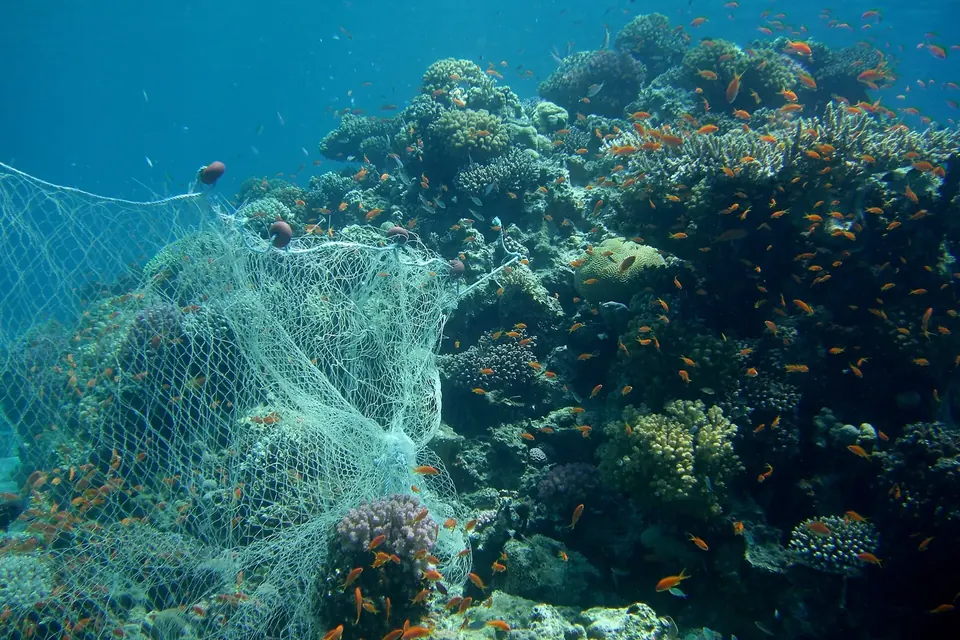
Abandoned, lost or otherwise discarded fishing gear is one of the most harmful forms of marine litter. A 2009 report by the UN Food and Agriculture Organization and the UN Environment Programme estimated that such gear made up around 10% of all marine litter, some 640,000 tonnes. Lost nets keep catching fish, turtles, seabirds and marine mammals, a process known as ghost fishing, and they damage reefs and seabeds. Most gear, the report found, is not dumped deliberately but lost in storms, strong currents or conflicts with other gear.
Nylon fishing nets are, however, a fairly homogeneous material. Several fibre producers now collect used nets, along with other nylon waste such as carpet fluff and factory scraps, and regenerate them into new yarn. The resulting fibre performs like virgin nylon, which is why it has spread so quickly through swimwear and activewear.
"Made from ocean plastic" and "made from recycled nylon" are not the same claim. Much recycled nylon comes from land-based or industrial waste rather than nets recovered at sea. Both are better than virgin fibre; the precise source should be stated, with a percentage, and backed by independent certification.
Recycled polyester
Recycled polyester for swimwear is mostly made from plastic bottles. It reduces demand for virgin polyester, but it moves bottles out of a bottle-to-bottle recycling loop into a textile that is much harder to recycle again. True textile-to-textile recycling of polyester is developing but still small. The Ellen MacArthur Foundation's headline figure, that less than 1% of material used to produce clothing is recycled into new clothing, applies to swimwear as much as anything else.
The problems still to solve
Elastane
Almost every swimsuit blends its main fibre with elastane. The blend is what makes the garment work, and what makes it hard to recycle, because the fibres have to be separated. Elastane is also the first part of a swimsuit to fail, so it limits lifespan. Research into separable or recyclable stretch fibres continues, but for now the practical answer is design and care that extend life.
Microfibres
Recycled or not, synthetic textiles shed microfibres when washed. The Ellen MacArthur Foundation estimated that around half a million tonnes of plastic microfibres reach the ocean each year. Swimwear sheds less than fleece, but hand-washing in cool water and avoiding machines reduces the problem further.
Overproduction
A recycled swimsuit that is worn for a week and discarded is still waste. The most significant changes in the industry are therefore not only about fibre:
- Made-to-order and small-batch production, which avoids unsold stock.
- Timeless cuts and colours rather than seasonal prints.
- Repair services and spare parts such as straps and cups.
- Take-back schemes that collect worn suits for recycling where possible.
- Resale of barely worn swimwear.
The role of design
Much of a swimsuit's environmental profile is decided on the designer's desk. Choices that make suits last longer and easier to recover at the end include:
- Fewer different materials in one garment, so that it is easier to recycle.
- Removable cups, rings and decorations rather than glued-in components.
- Strong, enclosed elastic at the stress points, where suits usually fail first.
- Fabrics tested for chlorine and UV resistance, with honest care labels.
- Patterns that carry over between seasons, so that sizes and colours can be restocked rather than replaced.
None of these are new technologies. They are the same principles of durability and repairability that EU ecodesign rules are designed to make standard across textiles.
Regulation is catching up
In the European Union, several rules are pushing in the same direction. The revised Waste Framework Directive, in force since 16 October 2025, requires every member state to set up extended producer responsibility schemes for textiles, so that producers pay for collection, sorting and recycling, with fees that can vary according to how sustainable products are. The Ecodesign for Sustainable Products Regulation enables durability and recyclability requirements for textiles, and since 19 July 2026 bans large companies from destroying unsold apparel and footwear. From 27 September 2026, generic environmental claims without proof are prohibited across the EU.
How to tell the leaders from the followers
- The composition label gives the exact share of recycled fibre and its source.
- The brand names its fibre suppliers and factories.
- Collections are small, cuts are repeated season to season, and sizes are restocked rather than replaced.
- Care instructions are detailed, and repairs or spare parts are offered.
- There is a credible plan for the end of the garment's life, not just its beginning.
For choosing and caring for a suit yourself, see our buyer's guide to sustainable swimwear.
The revolution in swimwear began with the fibre. The next one is about how long a suit is worn.
Sources
- FAO (2009), Ghost nets hurting marine environment (FAO/UNEP report on abandoned, lost or otherwise discarded fishing gear).
- Ellen MacArthur Foundation (2017), A New Textiles Economy, summary of findings.
- European Commission, Revised Waste Framework Directive enters into force (16 October 2025), and EU Strategy for Sustainable and Circular Textiles.
- Directive (EU) 2024/825 on empowering consumers for the green transition.
 Materials & footprint
Sustainable swimwear: a buyer's guide
Recycled fibres, durable fit, and the care routine that doubles a swimsuit's life.
 Materials & footprint
How fashion wastes water
Thirsty crops, polluting dye houses, microfibres in the wash, and what actually helps.
 People & power
Does sustainable fashion need a reboot?
A decade of 'eco' collections has not shrunk the footprint. What would?