How to read a clothing care label: every laundry symbol explained, and when to ignore it

The small label in the side seam is the only instruction manual most clothes come with, and it is written in a code few people were ever taught. Learning to read it takes ten minutes. It saves shrunken jumpers, faded colours and melted synthetics, and it tells you which "dry clean" warnings are real and which are a manufacturer playing safe.
Where the symbols come from
Most of the world uses one family of pictograms, developed in Europe by GINETEX, the international association for textile care labelling, and published as the international standard ISO 3758 (its fourth edition appeared in 2023). The symbols are protected trademarks in many countries, which is why they look identical from one brand to the next. In the European Union, care labelling is voluntary: EU law requires the fibre composition to be shown, not care instructions, but almost every garment carries them anyway.
The United States is different. Under the Federal Trade Commission's Care Labeling Rule, manufacturers and importers must attach permanent care instructions to clothing, and they must have a reasonable basis for them, meaning evidence that the recommended method will not damage the garment. Words are mandatory unless symbols are used, and the FTC accepts the American ASTM symbol set rather than the ISO one. The two systems share the same five basic shapes, so the guide below works for both, with a few differences noted.
One point in the US rule changes how you should read any label: if a garment can be both washed and dry cleaned, the label only has to give one of those methods. A "dry clean" label therefore does not prove that washing would ruin the garment. It only proves that dry cleaning was tested. The FTC's guidance for business, Clothes Captioning: Complying with the Care Labeling Rule, sets this out plainly.
The five shapes
Every symbol is built on one of five shapes, always in the same order on the label:
- A tub for washing.
- A triangle for bleaching.
- A square for drying.
- An iron for ironing.
- A circle for professional cleaning.
Two modifiers apply across the board. A cross through any symbol means "do not". Bars underneath mean "gentler than normal", and two bars are gentler than one.
Washing: the tub
The number inside the tub is the maximum water temperature in degrees Celsius: 30, 40, 60, 70 or 95 on European labels. American labels often use dots instead, from one dot for cold water up to six for the hottest wash. One dot corresponds to a cool wash of about 30 °C, two to about 40 °C, three to about 50 °C; above that, few everyday clothes need to go.
The bars matter as much as the number. According to GINETEX's own explanations of the symbols, one bar under the tub calls for a milder cycle with reduced mechanical action, the kind of programme suited to synthetics and "easy-care" fabrics; two bars call for a very mild cycle, the one used for machine-washable wool. A tub with a hand in it means hand wash only, at no more than 40 °C. A crossed-out tub means the garment should not be washed in water at all, at home or elsewhere.
Treat the temperature as a ceiling, not a target. Washing at 30 °C a shirt that is rated for 40 °C does it no harm, saves energy and is gentler on colours and elastane. Our guide to better fashion habits covers washing less and cooler in more detail.
Bleaching: the triangle
- Empty triangle: any bleach, chlorine or oxygen-based.
- Triangle with two diagonal lines: oxygen bleach only. Most universal detergents already contain oxygen bleach; chlorine bleach is off-limits.
- Crossed-out triangle: no bleach at all, so use a detergent without bleaching agents (colour and wool detergents usually qualify).
Chlorine bleach destroys wool, silk and elastane and strips many dyes. If you are treating a stain, check this symbol before reaching for anything stronger than detergent; our article on stain removal lists gentler options by type of stain.
Drying: the square
A square on its own means drying. What is drawn inside tells you how.
Tumble drying
A circle inside the square means the garment can go in a tumble dryer. One dot means a low-heat, gentle setting; two dots mean normal heat. A crossed-out version means do not tumble dry, which is common on wool, on garments with elastane, and on anything printed or coated. GINETEX notes that when no tumble-drying symbol appears, the washing and ironing symbols give a hint: the more robust a garment is in the wash and under the iron, the easier it is to dry.
Natural drying
Lines inside the square describe drying without a machine:
- A curved line along the top: hang on a line or a rack.
- Three vertical lines: drip dry, hung up while still wet, without spinning or wringing.
- One horizontal line: dry flat, the usual instruction for knitwear, which stretches under its own weight when hung.
- A diagonal line in the top corner: dry in the shade, for colours that fade in sunlight and for silk.
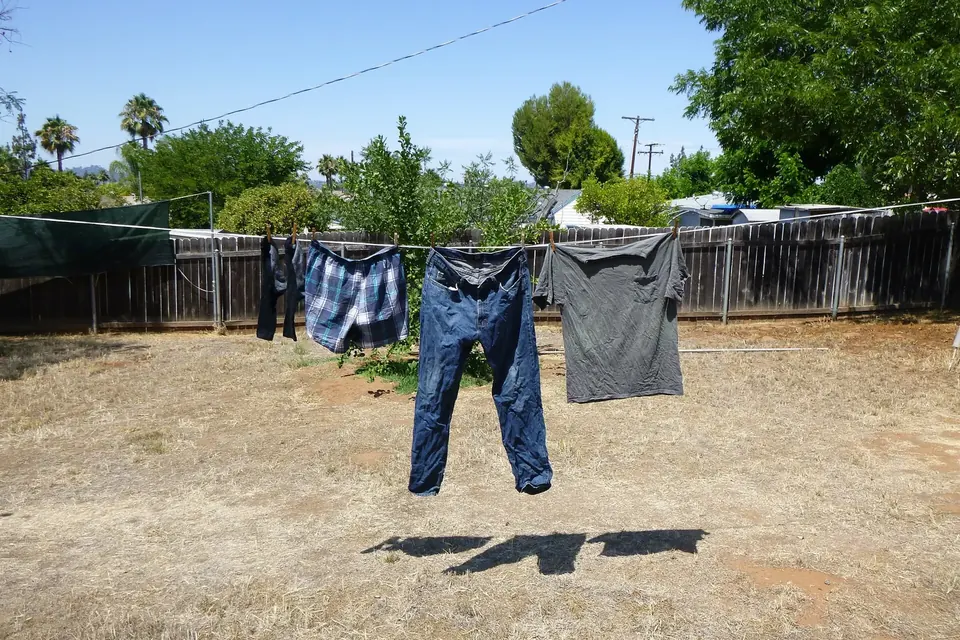
Line drying is free and kind to fibres, which is why it is the best habit to build even when the label allows a dryer.
Ironing: the iron
Dots inside the iron give the maximum sole-plate temperature. GINETEX publishes the figures: one dot means up to 120 °C (acrylic, polyamide, acetate), two dots up to 160 °C (wool, silk, polyester, viscose), three dots up to 210 °C (cotton and linen). An iron with crossed-out lines underneath it means no steam; a crossed-out iron means do not iron at all, usually because of a print, a coating or a fibre that melts.
Two practical rules help when a garment mixes fibres or the label has faded: always iron at the setting of the most delicate fibre, and iron dark or shiny fabrics inside out or under a cotton pressing cloth.
Professional cleaning: the circle
The circle is addressed to the cleaner, not to you, but it is worth reading. A letter inside tells the professional which process is safe:
- P: dry cleaning with perchloroethylene or hydrocarbon solvents.
- F: dry cleaning with hydrocarbon solvents only.
- W: professional wet cleaning, a water-based process with computer-controlled machines and special detergents.
A bar under the circle signals a gentler process, and a crossed-out circle means no professional dry cleaning. If you see a W, you have a choice: wet cleaning avoids solvents altogether. Our guide to breaking up with your dry cleaner explains how to find one that offers it.
When a label is over-cautious, and when it is not
Care labels are written to protect the brand as well as the garment. Because a manufacturer only has to name one safe method, "dry clean" is often the cheapest instruction to justify, especially on garments with linings, interfacings or mixed fibres. That does not make it wrong, and experimenting has limits. Some reasonable rules of thumb:
- "Dry clean" on a simple garment in cotton, linen, polyester or many wool knits is often a safe-play label. A gentle hand wash in cool water, with a test on an inside seam first, frequently works.
- "Dry clean only" deserves more respect. Tailored jackets, structured coats, pleated or glued garments, velvet, taffeta, leather trims and many viscose and acetate pieces can shrink, pucker or lose their shape in water.
- A crossed-out tub means water itself is the risk. Believe it.
- No label at all, as on many vintage and second-hand finds: identify the fibre if you can, then start with the gentlest method that fibre tolerates, a cool hand wash and flat drying.
If you remove labels because they scratch, photograph them first. A folder of label pictures on your phone is the easiest way to keep the instructions without the itch.
A ten-second routine
Before a new garment's first wash, read the label left to right: maximum temperature and number of bars; bleach allowed or not; dryer or line, flat or hung; iron dots; and whether professional cleaning is wet or solvent-based. Then sort your laundry by bars as well as by colour. That one habit, putting the two-bar woollens and one-bar synthetics on gentler cycles, prevents most of the damage that sends clothes to the bin early.
The label gives the limit, not the target: colder, gentler and flatter are almost always safe.
Sources
- Federal Trade Commission, Clothes Captioning: Complying with the Care Labeling Rule.
- GINETEX, Care symbols: washing, bleaching, drying, ironing and professional care.
- International Organization for Standardization, ISO 3758:2023, Textiles: Care labelling code using symbols.
 Care & repair
Break up with your dry cleaner
Why perc is being phased out, what wet cleaning is, and how to wash 'dry clean only' at home.
 Care & repair
The art of stain removal
Protein, tannin, grease, dye: identify the stain family, then treat it the right way.
 Wardrobe
Better fashion habits
Wash cooler, dry flat, store well, mend early: twelve routines that add years.